Shared Candles, Separate Wishes: Ordering a Joint Birthday Cake That Works

Photo: CEphoto, Uwe Aranas, CC BY-SA 3.0, via Wikimedia Commons
Joint birthdays are one of those lovely ideas that can get complicated somewhere between the group chat and the cake order. Perhaps you've got twins turning nine, siblings with birthdays four days apart, a couple whose dates fall in the same week, or two friends who've decided that turning forty is better done together. One cake sounds sensible. One cake also has to carry two names, two sets of preferences, and possibly two very different ideas about whether fruit belongs anywhere near a celebration.
The good news is that a shared cake doesn't have to be a compromise cake. With a bit of gentle negotiation up front, it can be the best kind of centrepiece: generous, personal, and genuinely enjoyable to cut into. Here's how we'd approach it if you were standing in our kitchen, notebook in hand.
Start with the guest of honour question
Before anyone opens a Pinterest board, ask a simple question: who is this cake actually for? If it's for two children sharing a party, their wishes should lead, even if the adults are paying. If it's for a couple marking milestone birthdays together, the cake might be more about the two of them than the room. And if it's for friends whose birthdays happen to land in the same week, the cake may simply need to acknowledge both without turning into a full diplomatic summit.
It helps to name the priority out loud. Something like: "We want one cake that feels like both of us, and we're happy to let the baker choose the design detail." That single sentence prevents most of the trouble.
A split design beats a swirled one
When two people want different things, the instinct is often to blend them. Resist that instinct. A cake that is half woodland theme and half football pitch, blended into a swirl of green and white, tends to look like a mistake rather than a collaboration.
A cleaner approach is to split the cake clearly. One side can carry one person's favourite colours or motif; the other side carries the second person's. A neat vertical divide, a shared base, and a single message across the top can look intentional and rather smart. Alternatively, keep the outside simple and let the differences live in small details: two figures on top, two sets of initials, two sugar flowers, or a ribbon in each person's favourite colour.
If the two guests of honour have wildly different tastes, the safest route is a shared neutral base—white buttercream, soft ivory, a gentle pastel—with individual touches added on top. That way the cake reads as one celebration, not two orders that collided in transit.
Flavour: one cake, two tastes
Flavour is where joint cakes can get genuinely tricky, especially if one person adores chocolate and the other thinks chocolate is a bit much after a buffet. You have a few realistic options.
First, choose a crowd-pleasing middle ground. A vanilla sponge with raspberry jam and buttercream is popular for a reason: it suits almost everyone, including grandparents and small children. A light lemon cake is another safe pair of hands. Second, consider a two-tier cake with different flavours in each tier—chocolate on the bottom for the chocolate person, vanilla or lemon on top for the other. It looks generous and solves the problem without anyone having to announce a favourite.
Third, if the cake is small and the guest list is mixed, don't overthink it. Pick one excellent flavour and put your energy into the message and the moment. Nobody has ever complained about a well-made Victoria sponge at a birthday party. Well, nobody we've baked for.
The wording on the cake
This is the bit that causes quiet offence if it goes wrong. Two names, one message, and limited space. Our advice is to keep it simple and balanced.
- Put both names at the same size, unless one person has specifically asked not to be named.
- Use a joint phrase that doesn't rank anyone: "Happy Birthday, Alex & Sam", "Happy 40th, Jo & Priya", or "Twins at Ten" all work.
- If ages differ, you can include both numbers, but it's often cleaner to leave ages off the plaque and mention them in the card or on a small tag.
- Avoid jokes that only one person will understand. A shared cake should feel shared.
If one guest of honour is a surprise—a partner organising a joint party for the other, for example—tell the baker clearly. It's much easier to keep a secret if we know it's a secret.
Portions when the guest list is shared
A joint party can mean a bigger room than usual, so portion planning matters. As a rough guide for a British party with a buffet, a six-inch cake serves around ten to twelve modest slices, an eight-inch serves twenty to twenty-four, and a ten-inch comfortably covers thirty-five to forty. If the cake is the main dessert, lean towards the higher number. If there's a table of sausage rolls, quiche, and a mountain of crisps, people will take smaller slices.
It's also worth deciding early whether the cake is being cut at the party or sent home in boxes. A shared cake that gets cut late, when everyone is tired, often leaves half its slices untouched. A gentle announcement—"cake is being cut in ten minutes"—works wonders.
Candles, twins, and the small rituals
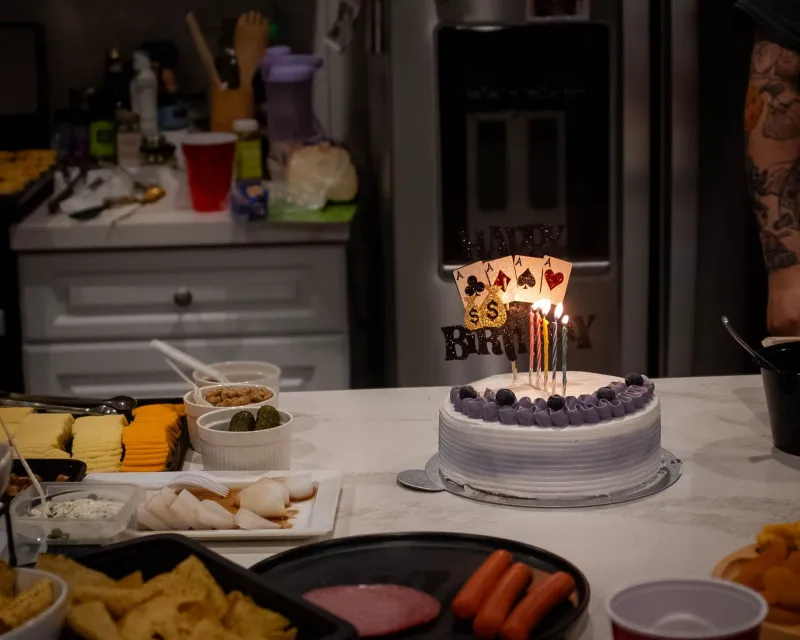
For twins or siblings sharing a birthday, the candle moment matters more than the design. Two sets of candles, two wishes, and a clear plan for who blows first avoids the mild chaos that otherwise follows. Some families sing twice, some sing once with both names, and some let the youngest go first. There's no rule, but agreeing beforehand keeps it sweet.
For couples, a single cake with two candles can feel lovely and understated. For friends sharing a week, a cake with both names and a simple message is usually plenty. The point is not to make the cake prove anything. The point is to give both people a moment in the spotlight.
When one cake isn't the answer
Sometimes the kindest solution is two small cakes rather than one large one. Two six-inch cakes, each with its own flavour and message, can cost less than one complicated two-tier design and often feel more personal. They also let each person choose exactly what they want without negotiation. If the guests of honour have very different tastes or the party has two distinct halves, this is a genuinely good option.
We've baked plenty of joint cakes at Cakes by Dawn, and the ones that work best tend to share a few things: a clear brief, a simple design, and two names that are given equal weight. If you're planning a shared celebration this year, bring us the guest list, the two sets of preferences, and the honest budget. We'll help you find the cake that lets both people feel like the reason for the party.